My journey in collecting baseball cards of a player most people haven't heard of.
Tuesday, December 25, 2012
Year in Review
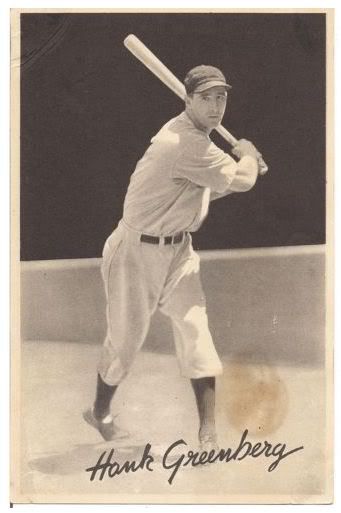
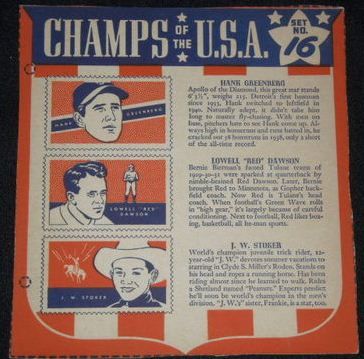
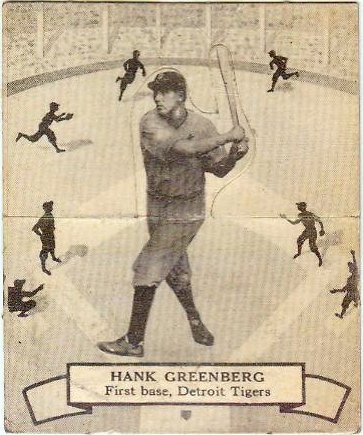
From my memory, the first card I purchased in 2012 was this premium from 1936 (Greenberg is pictures in the first row last on the right):
The next premium I got was a rather inexpensive 1950 Indians team issue. This large card pictures Greenberg as the GM of the Cleveland Indians.
The next premium is a favorite of mine, from 1939 Goudey, Black & White variation. My favorite part of this card is actually the back, which I do not have a scan of. It features a very dumbed-down explanation of how to hit; everything from the stance to hand positioning, etc.
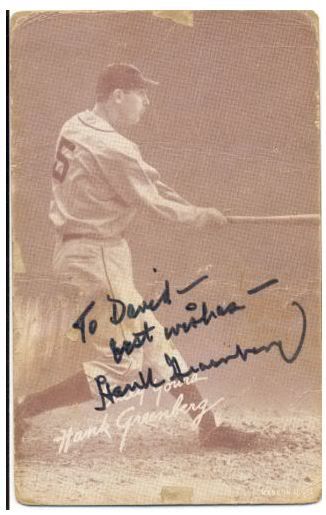
The next card is a first of me. A signed vintage card of Hank. 1939-46 Exhibits Salutations.
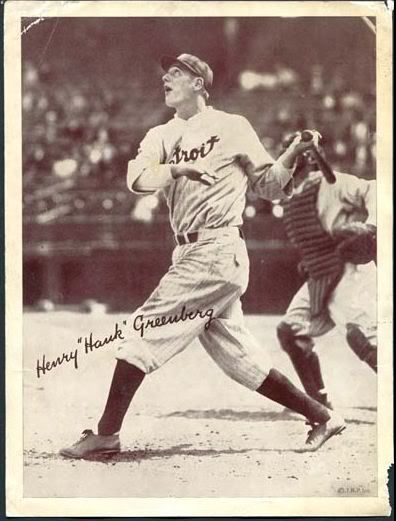
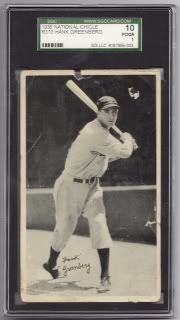
This card is a rather large, rather damaged, but nice premium from 1936 R311.
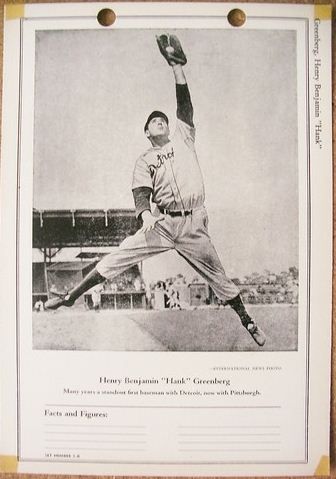
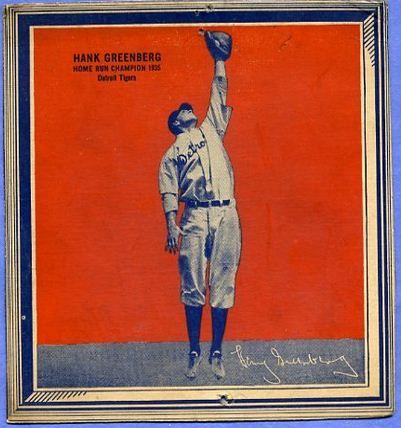
This next premium measures 7''x10'' and features a nice photo of Greenberg leaping in the air. It cost me a little bit more than I'd like, it has punch holes in the top, but is a rather awesome card to own from 1948-9 Sports Exchange All Stars set
The next card began a slew of Wheaties premiums that were originally cut out from the backs of Wheaties cereal boxes.
Another Wheaties panel.
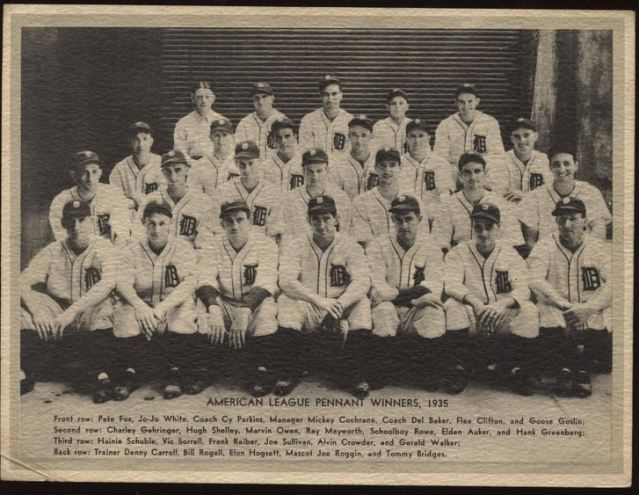
This next premium was my only purchase at the National. 1936 R311 Leather Detroit Tigers team photo. Greenberg is second row up last on the right.
This premium is a gorgeous Wheaties premium. Got it for a good price, very happy with it.
And the final card of 2012 was the most recently acquired 1939 Play Ball Sample back
Thanks all! Hope 2013 is a good year for everyone.
-Brian
Sunday, December 23, 2012
Condition doesn't mean shit
There is definitely an affinity with cards with the sharpest corners, with the most vibrant colors, the straightest edges. But these cards cannot tell a story. What does a perfect card say about it's original owner? Probably nothing worth knowing, or interesting enough to want to know.
I like to hear of a card's journey. Recent attic finds totaling $500,000+ is interesting to hear about, but those cards were stashed away for 90 years. They sat, and sat, and sat. My money is on the fact that the original owner of the cards probably forgot that he even had them. Which is a travesty in of itself.
I want to hear stories about how the cards was flicked against the side of a brick wall, about how they were stuck in bike spokes to make riding a bike sound like riding a chopper. Some people grimace at the sound of those stories, especially when it involves a card of high "value". See, there's that word again..
I am so content with the value of my collection, and the condition of the cards in it. I know that I might never own a card worthy of the Hall of Fame, but I couldn't care less.
I don't really know how I want to end this post, but maybe leave you all with something to chew on..
If you were building a collection starting today, what would it be, and what would you base the value of it on?
Monday, November 19, 2012
What do I win?
Today I had a unique experience with a card that I have owned for the better part of 4 years. It's not even a card I particularly love. This card has been a staple in my collection, and before tonight I thought was one of the more common vintage cards I owned.
That was before about 2.5 hours ago.
In a conversation with my cousin Steve about the Play Ball sample card he got on eBay a couple of weeks ago, I learned that the 1939 Play Ball card that I own is in fact rare.
Steve was telling me how the only card he needs to complete his 39 Play Ball set is the lowercase name variation. I didn't know this was even a variation. I thought back to my own copy of this card, and remembered thinking that the name was lowercase, like in the picture shown. Apparently, the variation is pretty rare. But how rare?
I'll have to do some more research. But all I need now to complete my set is the most common card; the all uppercase version of the regular card.
Thanks Steve!
"So, what do I win?"
Monday, November 5, 2012
HUGE CARD LANDED: Could be my Rarest card
Each of the first 115 cards in the 1939 Play Ball set can be found with red overprinting on the back indicating sample card status...
Collectors will pay a small premium for a type card of a common player. Sample cards of most star players will sell for about double the price of the regular-issue cards, while DiMaggio and Williams samples sell for about the same price as their regular-issue cards.2011 Standard Catalog of Baseball Cards -- Lemke
You could count the total number of sample cards that I have seen on eBay on one hand. This, and the 1941 Play Ball Paper variation are two obscure, and incredibly rare variations. Think of what kids did when they got these cards. Something with a red stamp on the back of their card? Right in the trash. The scarcity of these cards are unknown, but some information has been gathered about how this card was distributed in 1939. This promotional advertisement card was handed out at ballparks and other such venues to create excitement for their new Play Ball gum cards and product.
I think I got this card at a great price, and I'm very happy with it. Also, please comment and share this blog/story with whomever you feel would like to follow it. Let me know if you would like to see more videos in the future, or if I should stick to scans.
Thanks ------
Wednesday, October 31, 2012
CARD LANDED: Not what you'd expect...
"This 12-card set was issued in 1976 by Playboy Press to promote author Bert Randolph Sugar's book "Who Was Harry Steinfieldt? & Other Baseball Trivia Questions. The black and white cards measure the standard 2.5'' x 3.5'' with a player photo on the front and a trivia question and ad for the book on the back."
Friday, September 14, 2012
Card(s) Spotlight: 1935 Diamond Stars #54A & #54B
Issued by the National Chicle Gum Co. of Cambridge, MA, the set was produced for 3 years, between 1934-36. As players would make their debut in the majors, or become prominent enough to warrant being placed in the set, they were placed accordingly. Featuring drawn players strewn across pastel backgrounds of stadiums and scenery, these cards have become a favorite set to collect among pre-war set, type and player collectors.
Hank Greenberg actually has two cards that were produced in this set.
This was the first card produced in the set. However, an error made it's way past the editors and onto the card. Can you spot it? Hank GreenbUrg never played a single major league game, but Hank GreenbErg nearly 1,400 games in his career.
This error, as well as the error with Ernie Lombardi's card were quickly brought to the attention of those in charge, and were corrected in subsequent releases of the product. So in turn, this card became highly sought after because of it's rarity.
Typically, the cards in this set do not look like the card to the left. This card has been made a work of art by a 10 year old that didn't like the white border around the card. I bought it for about $12, and it will remain a place holder in my collection until I can afford to purchase one in a condition I feel is adequate enough.
The card that was the result of a printing error was this on the right. Notice the U changed to an E. There is a significant difference in the value of the error compared to that of the corrected card. Although the corrected card "books" (hate this term by the way) at $400 in Near Mint condition, and the error "books" at $600 in Near Mint condition. Well let me tell you something about book value Beckett. An error card that is in NM condition in an SGC or PSA holder will never, ever, EVER EVER EVER sell for $600. It will sell for much more. That is for another post though. Sorry about that.
Anyhow, this card had eluded me for sometime before I was finally able to land it in a private deal. I am guessing that I might have been outbid/lost out of 15 or more different cards similar to this one before finally acquiring it. I might have overpaid for it at $100, but I NEEDED this card. It is a staple for any Hank Greenberg collection.
I know that I am not the only Hank Greenberg collector out there, and I am not striving to be the best, most high-dollar spender there is. I just know that I probably won't stop until this project is over and done with, and I can look at the collection as a whole and reminisce to myself about the journey, the struggles and the triumphs.
Thanks all.
[Information gathered from Old Cardboard]
Monday, September 3, 2012
Why this set is so difficult to complete

As my collection grew and grew, I quickly came to the realization that I am not the only Hank Greenberg collector in the world. Countless times at card shows I would ask a dealer what he had, he would routinely say, as if it were a sick joke, that he just sold a card that I needed.
I still do not know how many cards are in the master set (I should really get on that) but I would guess it is about 50-60 or so, and I think I am half way there, with some serious cards still to be acquired.
The last two cards I hope to acquire to finish my journey will be the 1938 R301 Overland Candy Wrapper (which isn't really a card at all) and the 1935 Goudey R309-2. Both incredibly rare, and incredibly condition sensitive. I saw an Overland wrapper at the most recent National Sports Collectors Convention in Baltimore, MD that was being sold for $2,100. Needless to say, I didn't negotiate for it.
This realization has taught me that all of my collecting doesn't )and won't) happen in the present. This journey will take longer than expected, but it will be worth it in the end.
But the 1938 R301 and 1935 R309-2 aren't the only cards I am worried about. Although not in the thousands of dollars, the 1937 V300 O Pee Chee is a card that tends to get very pricey. There was a PSA 2 card that sold for $245 on eBay that I should have pulled the trigger on. I feel like I'm going to regret that one for some time..
Another card that is tough is the 1936 V355 World Wide Gum. At one point I was offered a SGC 20 V355 for $425. That shit ain't happenin'. I was also burned on this card. One went up maybe a year and a half ago for $149 that was a SGC 10, and I waited on it and was beat by somebody else. Live and learn.
What really hinders my collection is my inability to drop money on higher end cards. For other collectors it seems it is easier for them to amass more expensive cards and in better quality. I'm a completest; to me condition is not a big issue. As long as the card looks nice I am open to buying it.
Hank Greenberg, according to Frank Ward, resident vintage baseball card guru is one of the top 10 vintage players to collect. Jewish player collectors love to buy his stuff, and it seems that sellers always want it because it sells so well. The competition for the more scarce and high dollar cards is high, but I'm determined to eventually finish the set. The fact of the matter is, there are a lot of collectors of Hank Greenberg, meaning that once these cards are bought, they will remain in someone's collection, and likely never see the light of day again. Once they are gone, they are gone, making a card rarer and rarer by the day.
There are some cards that were produced one Hank Greenberg that I still to this day have seen available at auction. There are still some issues being discovered today, as original collectors are passing away and their estates sold. This hopefully will make some more of the rare issues more common, if even possible. Because some of these issues are so rare, when they do show up for auction, they command a huge premium, for the reason being no one knows when the next card will surface.
This journey will be taxing, both on my time and wallet.
I will finish it.
Stay tuned.